Why does so much of modern life exhaust us?
Open your news app, and the headlines read like caricatures of catastrophe. War. Wildfires. Hunks of space junk falling from the sky.
Other parts of your smartphone start tugging your sleeve. Instagram wants you to waste an hour on Reels. Gmail warns you about an ungodly unread count. You get texts about bills to pay, meetings you’re missing. A push notification comes through – Donald Trump wants to rename the Strait of Hormuz after himself.
Early in our second section of Infinite Jest (pages 60-123), we meet Gerhardt Schtitt, the Head Coach and Athletic Director at the Enfield Tennis Academy. Schtitt has a history of near-violent tennis instruction. And he likes eating ice cream with Mario Incandenza.
As he sits with Mario one evening behind the Headmaster’s House, Schtitt smokes a “post-prandial” pipe and sums up his view of the world.1 It sounds an awful lot like our own:
“Gerhardt Schtitt does not so much dislike the modern O.N.A.N.ite U.S. of A. as find it hilarious and frightening at the same time. Probably mostly just alien.”2
Hilarious, frightening, alien.
The NATO Secretary General calling Trump “Daddy”? AI companies giving their own tech a 10% chance of ending everything?
Tick, tick, tick.
As we settle into Infinite Jest, we find it supremely interested in the origins of a viewpoint like Schtitt’s. In articulating not just what we feel about modernity, but why.
Schtitt actually sums it up nicely later on in his conversation with Mario:
“…WE ARE WHAT WE WALK BETWEEN.”3
This is what Infinite Jest introduces us to as its plot unfolds: the two invisible ends of a spectrum of modern experience. And why walking between them makes the world feel the way it does.
Hilarious, frightening, alien.
So what do we walk between – in Infinite Jest or otherwise? Wallace sets the scene for us in the form of Hal’s recurring nightmare.
We presume it’s Hal, at least, from the use of first-person and his comments on “having taken certain vows early on concerning fathers and differences.”4 We know Hal sneaks down to the E.T.A. Lung Room to get high. Here we discover where it started: “late-night bongs, as a kind of psychodysleptic Sominex, to help [Hal] sleep.”5
Hal dreams of tennis, of course, and two aspects of his imagined matches make them particularly horrifying.
The first problem is the Grand size of his imagined tennis court. It is “gargantuan,” “about the size of a football field.”6 Hal can’t even see his “distant opponent” across the immense space.7 The umpire controls things from another great distance – from “high overhead,” “near what might be a net post.”8 Their whispered directives remain unclear to Hal on the ground.
The second element exists on the Granular level, as a complement to the first nightmare of the Grand.
Hal’s tennis court isn’t simply cyclopean – it is unfathomably complicated. “The lines” appear “as complex and convolved as a sculpture of string.”9 They “run oblique or meet and form relationships and boxes and rivers and tributaries and systems inside systems.”10
How can Hal play when the umpire’s rules from above are so distant and indistinct? How can he play when the lines from the court below are so numerous and confounding?
In his nightmare, Hal walks between the Grand and the Granular. So often in life, we do the same. What Infinite Jest clarifies is the way our modern lives set a path for us between Grand, global forces outside our control and Granular bureaucracy or algorithms outside our understanding. And the way modernity seeks to shape us by those boundaries.
You are what you walk between.
Infinite Jest explores the influence of Grand, global forces through the story of Marathe and Steeply.
The pair first appears on page 87, but we’d better get used to their barbed dialogue. They offer Wallace a regular opportunity to explore plot points at the highest scale of drama and intrigue.
Marathe represents Les Assassins des Fauteuils Rollents (the A.F.R.) – “one of the most feared cells in the annals of Canadian extremism.”11 They are terrorists, violently opposed to “both Quebec and Canada in toto’s ‘Sudetenlandization’ by the […] American-dominated Organization of North American Nations.”12 Steeply represents the “Office of Unspecified Services” – an O.N.A.N. initiative led by Rodney Tine: the “architect of O.N.A.N. and continental Reconfiguration.”13
Marathe and Steeply operate in a world of the most melodramatic political influence. They discuss a deadly “Entertainment” that the “Québécois Sepératiste Left” uses to send a message to the O.N.A.N. government.14 They reflect on double and triple agents. They sit closest to Infinite Jest’s wider and more ridiculous world – one defined by a “Great Concavity in what used to be Vermont,” by “[herds] of feral hamsters” and “giant protective ATHSCME fans” blowing “piss-colored [banks] of teratogenic Concavity clouds” away from cities.15
But our earliest encounter with Marathe and Steeply might reveal the most about their role in the novel.
As they sit on their outcropping with the sun setting behind them, Marathe and Steeply cast over Tucson a “Brockengespenst”: a “ghostly light- and monster-shadow phenomenon.”16 And they enjoy it. Marathe uses his hands to “make a huge and black blossom open itself and close itself.”17 Steeply “(makes) X’s and pedentive V’s over much in the city” by raising and crossing his arms.18
Here is that gargantuan tennis court again. The world of Big Things and Important People that cast shadows across ordinary lives. Here is the news that North Korea has tested another ballistic missile. That anti-vaxxers have infiltrated the government. How often do we wish some distant umpire would speak up or just stay out of it?
To flesh out the nightmare of those “complex and convulved” tennis court lines, Wallace uses a more visceral device.
The endnotes.
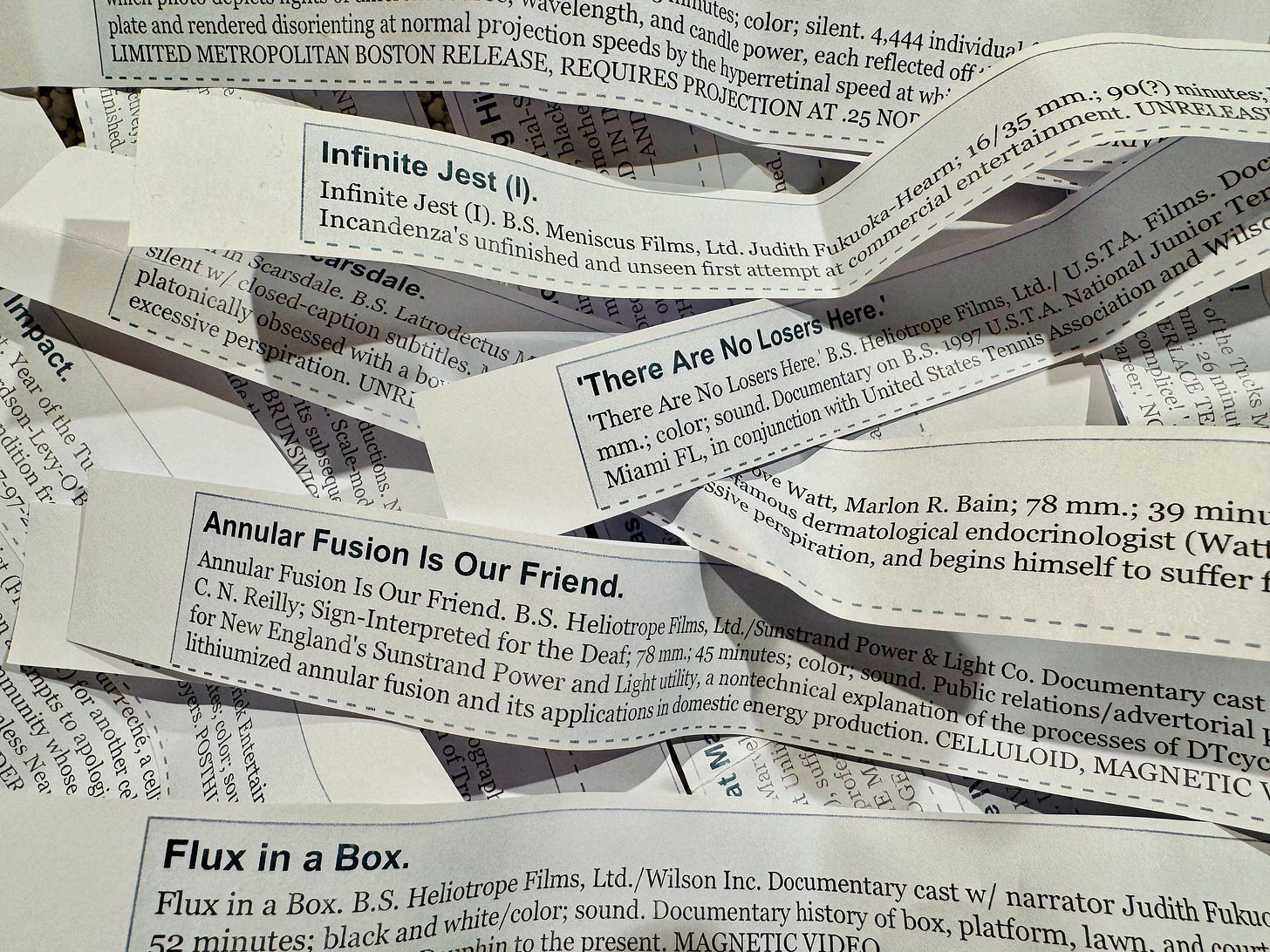
By page 64, we’ve already waded through 23 of the infamous endnotes at the back of Infinite Jest. But nothing could prepare us for number 24.
We get James Incandenza’s full filmography. Every film Hal’s father ever made – complete with actors and production companies, length and lens and celluloid or magnetic film type. Over eight pages of endnotes, complete with their own occasional footnotes.
That’s not even our most intricate endnote adventure. In the first section with Marathe and Steeply, endnote 39 takes us to a short description of M. Fortier, “Marathe’s superior in the A.F.R.”19 That endnote leads to two footnotes. And footnote b, mentioning that Marathe’s older brothers were “both struck and killed by trains,” refers us all the way to endnote 304.20 That’s seven more pages on the history of the “Wheelchair Assassins” and the “Russian-Roulettish-train-jumping-cult-thing” that sent them to their eponymous Fauteuils Rollents.21
There is plenty to love in the endnotes. Really. Push past your initial horror at heaving aside 900+ pages, at squinting through six-point font, and you’ll find diamonds in the rough. The listing for Incandenza’s “poststructuralist [antidocumentary]” about Americans named John Wayne who are not “the legendary” John Wayne.22 James Struck reading an article about the A.F.R. and thinking “there’s a kind of almost savage edge to the article’s incoherence that (he’s) getting almost to like, a little.”23 Might we feel similarly about Infinite Jest?
But reverse and reexamine that horror you’ve pushed past. It was a feature, not a bug.
The endnotes exist to garner our groans when we find another tiny number burrowed into a line. The disgust they evoke is a familiar one. It’s the same we feel when filling out tax returns. When we really do need to read the Terms and Conditions.
And the power they hold – the plot points they conceal at the back of the book – offers an interesting analogy for the algorithms that increasingly control us from the “back” of our online experiences.
Modern life is built on a bedrock of bureaucracy and algorithms: the forms, procedures, and programing that run contrary to almost every person’s sense of humanity and soul.
Here are the “rivers and tributaries and systems inside systems” from Hal’s nightmare. Here is the other side of what we walk between.
Look closely, and you’ll find Infinite Jest filled with characters living in the Brockengespenst shadows of the Grand or the bureaucratic control of the Granular.
Our medical attaché becomes a political tool of the A.F.R. Our friends at the E.T.A. are taught tennis as “patriotic play” – “how to learn to be a good American.”24
On the other hand, the bureaucratic hospital system considers Kate Gompert’s pain “depressing and boring and unpleasant.”25 The E.T.A. boys live within a machine of algorithmic precision. “You guys ever see evidence of the tiniest lack of coolly calculated structure around here?” Hal asks.26
But there are also the glimmers of a way out.
Gerhardt Schtitt has “one great irresistible attraction” as a tennis coach.27 He believes “the true opponent, the enfolding boundary, is the player himself.”28
“You seek to vanquish and transcend the limited self whose limits make the game possible in the first place. It is tragic and sad and chaotic and lovely. All life is the same, as citizens of the human State: the animating limits are within, to be killed and mourned, over and over again.”29
We are what we walk between – the Grand and the Granular. That’s how we’re defined in the twenty-first century.
But once we’re defined, once we’re given that “limited self”? That’s our opportunity to vanquish. To “[bring] ourselves to the table to hammer out” a set of better “terms.”30
That’s our chance to “transcend.”
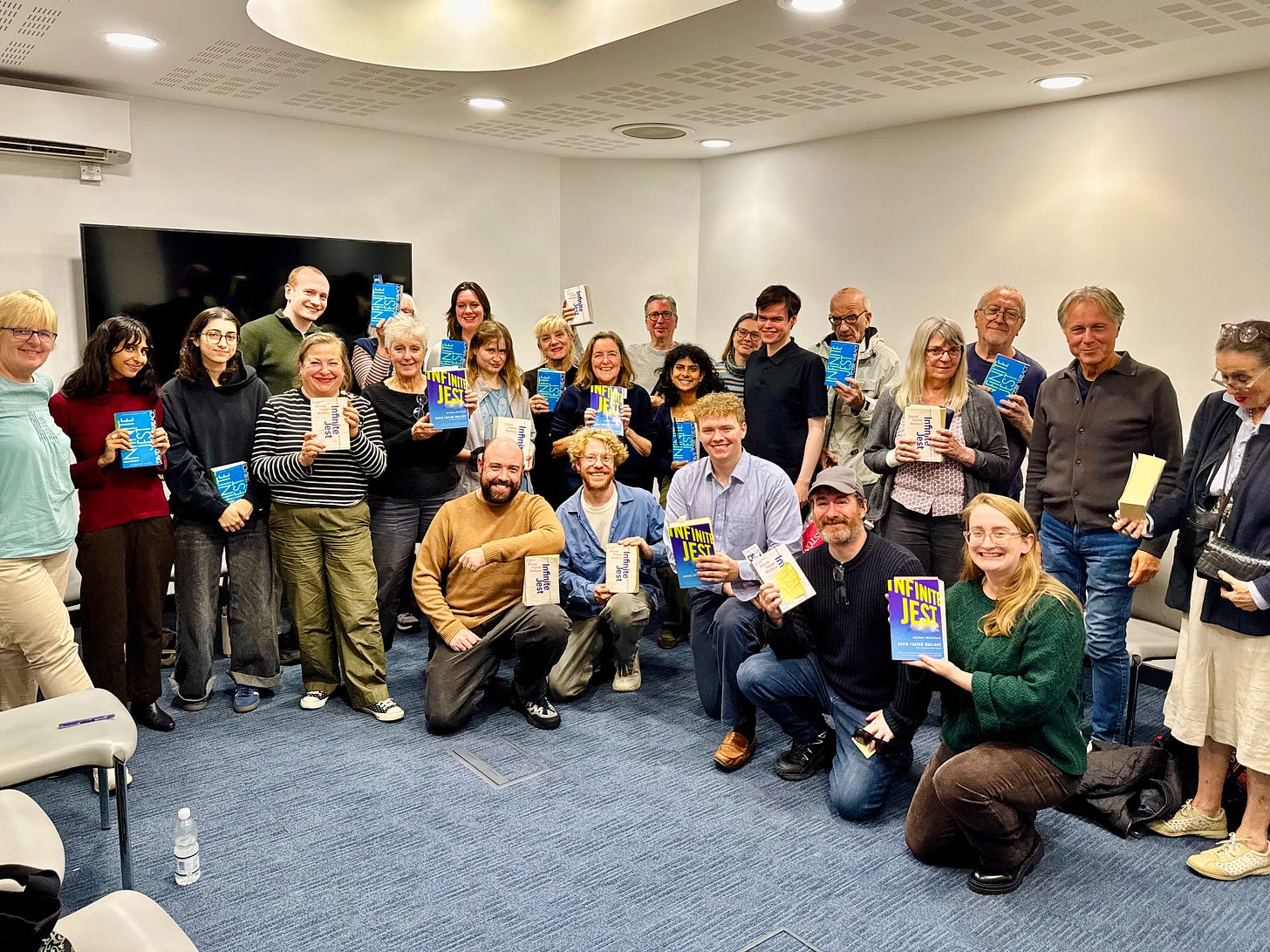
From October 2026 to April 2027, Fearless Fiction is reading, wrestling with, and reveling in David Foster Wallace’s postmodern masterpiece, Infinite Jest, for its thirtieth anniversary.
We are hugely grateful to the British Association for American Studies (BAAS) for sponsoring and supporting the project’s in-person edition, which guides a dynamic group of Londoners over the course of sixteen discussion sessions. Each week, participants read a section of Infinite Jest in advance and analyse the text together at the John Harvard Library in Southwark, London.
The digital edition of Fearless Fiction (this Substack) will explore and celebrate Infinite Jest in conjunction with the in-person group’s sixteen sessions. Its primary objective is to help a wider audience online use Infinite Jest to change the way we see ourselves, our neighbours, and our world. As a result, it will aim to offer a broad introductory guide to Infinite Jest informed by the group’s in-person discussions but capable of exploring the text beyond them.
References to page numbers correspond with the 10th Anniversary Edition from Back Bay Books, an imprint of Little, Brown and Company (ISBN: 9780316066525). This pagination matches that of the 30th Anniversary Edition from Little, Brown Book Group (ISBN: 9780349121086).
David Foster Wallace, Infinite Jest (New York: Little, Brown and Company, 2006), 82.
Wallace, Infinite Jest, 82.
Wallace, Infinite Jest, 81.
Wallace, Infinite Jest, 67.
Wallace, Infinite Jest, 67.
Wallace, Infinite Jest, 67.
Wallace, Infinite Jest, 68.
Wallace, Infinite Jest, 67-68.
Wallace, Infinite Jest, 67.
Wallace, Infinite Jest, 67.
Wallace, Infinite Jest, 1057n304.
Wallace, Infinite Jest, 1056n304.
Wallace, Infinite Jest, 92.
Wallace, Infinite Jest, 89-90.
Wallace, Infinite Jest, 93.
Wallace, Infinite Jest, 994n38.
Wallace, Infinite Jest, 91.
Wallace, Infinite Jest, 91.
Wallace, Infinite Jest, 994n39.
Wallace, Infinite Jest, 994n39.
Wallace, Infinite Jest, 1056-1058n304.
Wallace, Infinite Jest, 988n24.
Wallace, Infinite Jest, 1057n304.
Wallace, Infinite Jest, 120.
Wallace, Infinite Jest, 68.
Wallace, Infinite Jest, 114.
Wallace, Infinite Jest, 84.
Wallace, Infinite Jest, 84.
Wallace, Infinite Jest, 84.
Wallace, Infinite Jest, 84.


