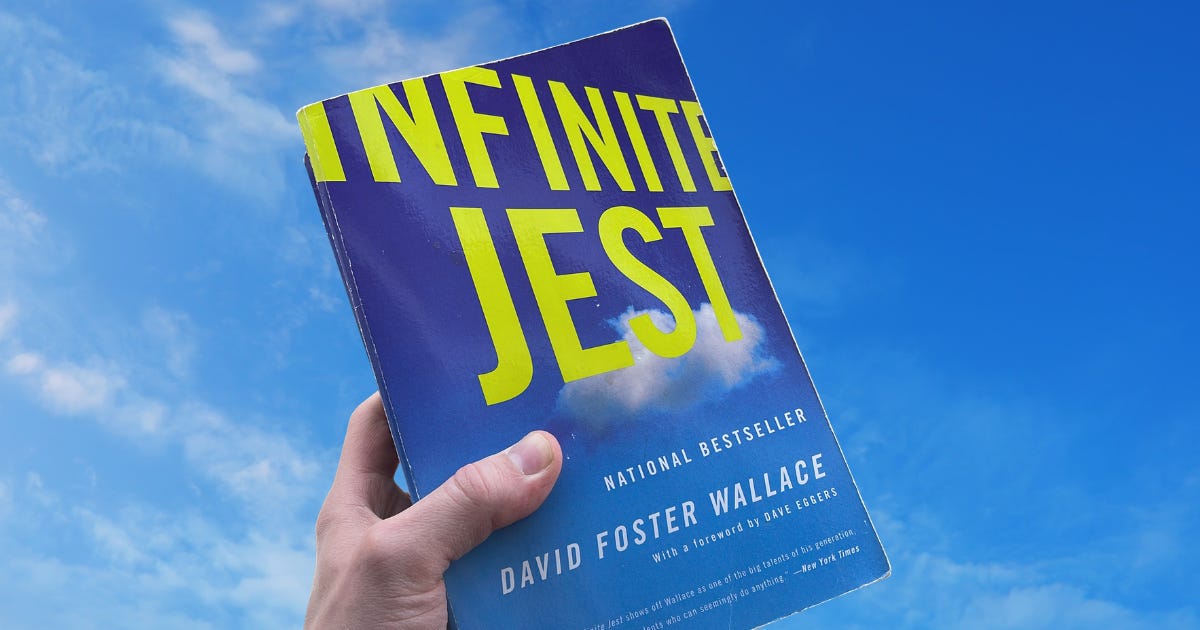
It is tempting to dismiss our strange friend Lyle.
You remember Lyle – the resident E.T.A. guru, that guy who balances himself on the weight room towel dispenser, who licks sweat off the tennis players in a way they seem to consider largely above board.
We first met Lyle briefly on page 127. We heard about his rough tongue – “like a kitty’s.”1 We probably welcomed the chance to forget about him.
Lyle reappears at the start of our fourth section of Infinite Jest. This time he speaks with an “extremely moist Graham Rader,” and again you might feel tempted to pass him quickly, to ignore the esoteric metaphor he outlines.2 He asks Rader to imagine holding a hundred keys, and knowing that one of them would “unlock it, this door we’re imagining opening in onto all you want to be, as a player.”3 He asks Rader how many keys the young player would test.
“‘Well I’d try every darn one,’ Rader tells Lyle. […]
Lyle never whispers, but it’s just about the same. ‘Then you are willing to make mistakes, you see. You are saying you will accept 99% error. The paralyzed perfectionist you say you are would stand there before that door. Jingling the keys. Afraid to try the first key.’”4
Wait a minute – that really was profound. If we force ourselves to linger on this moment with Lyle, two facts might strike us.
First, Lyle offers a genuine message of hope – of light – amid all the despair and darkness we’ve encountered so far. We hold the keys to our own liberation. We can “unlock all [we] want to be.” Failure once, twice, ninety-nine times does not prevent the possibility of our eventual success.
Second, Lyle’s parable provides a framework for understanding Infinite Jest’s broader approach to despair and hope. This text has become infamous for obsessing over life’s locked doors – addictions and anxieties, cruelties and killings. Again and again we meet characters “paralyzed” before those doors, or perhaps trying key after key in vain.
But the incredible thing about Infinite Jest – the thing that will bring me back for the rest of my life – is its bone-deep belief in the possibility of progress. In our eventual ability to unlock those doors.
From a distance, Infinite Jest can feel indifferent to human optimism – or explicitly disdainful of it. But look closely, and this nightmarish tour of suffering and sadness treats hope as something very serious.
Wallace believes we can hope. And that we should. This fourth section of the text offers some of the strongest examples to support that unconventional interpretation.
As we pass page 200, we’re forced to wrestle with some of the darkest examples of the text’s preoccupation with panic.
Take our prolonged journey with Joelle van Dyne. We learn right away that Joelle is “at the end of her rope and preparing to hang from it.”5 She feels “excruciatingly alive and encaged,” worn down by an addiction to “the Material” (freebase cocaine) that she “[wants] to stop and also couldn’t stop or imagine […] living without.”6
Joelle’s pain becomes all the more tragic when we understand her full complexity and three-dimensionality. Joelle is our mysterious Madame Psychosis from the WYYY radio show. She used to date Orin Incandenza, used to act as muse for his father Jim. Joelle played a critical role in “Jim’s unseen last cartridge” – the one people call “some kind of abstractable hypnosis, an optical dopamine-cue.”7
We don’t fully understand why Joelle wears a veil, what we’d witness if we saw “her unveiled face in the dirty lit mirror […] shocking in the intensity of its absorption.”8 Is she “too pretty for words, maybe the Prettiest Girl of All Time”?9 So why then does she associate with the Union of the Hideously and Improbably Deformed?
We wish she’d stick around for us to find out. We leave her vomiting into the bathtub, having “Too Much Fun for anyone mortal to hope to endure.”10
Later in this section, Hal and Orin’s phone conversation isn’t exactly upbeat, either.
Prior to this point we’ve heard mere suggestions for how James Incandenza met his demise. Now we get the gory details. Yes, Jim committed suicide. Yes, Hal was the one who found him.
And no, Jim didn’t put his head in the oven – it was the microwave. He got drunk on Wild Turkey, “used a wide-bit drill and small hacksaw to make a head-sized hole,” and subjected his head to the “equivalent in kg.s.cm to over two sticks of TNT.”11 “You must have been traumatized beyond fucking belief,” Orin tells Hal.12 It isn’t hard to understand why.
At this point, we’re not surprised to read about a suicide so graphic it causes the field pathologist himself to vomit while investigating. Even Hal’s cartoonishly cruel experience with trauma feels par for the course. What did he tell his grief-therapist he thought when entering the house with Jim’s microwaved remains? “That something smelled delicious!”13
It’s only when we return to Ennet House that we find something truly shocking. Something strange and unsettling even amidst all of Infinite Jest’s other oddities.
We find hope.
As Wallace reflects on addiction recovery facilities like Ennet House, he articulates the “many exotic new facts” they often teach residents.14 These turn out to be some of the most hopeful, optimistic, almost naively sentimental aphorisms anywhere in fiction:
“That there is such a thing as raw, unalloyed, agendaless kindness.”15
“That there might not be angels, but there are people who might as well be angels.”16
“That it is simply more pleasant to be happy than to be pissed off.”17
“That no single, individual moment is in and of itself unendurable.”18
Hold on. We’re 200 pages into the book that describes James Incandenza’s head “[popping] like an uncut spud.”19 That speaks indifferently of teenage tennis players using drugs to feel “like [their] soul [is] a wrung-out sponge.”20
Now what do we discover? Kindness. Angels. Our preternatural human ability to endure and overcome any obstacle.
Perhaps most striking is the fact that Wallace does not tell a story of courage or kindness. He just asserts their reality. He lays out progress and hopeful possibility as facts – immutable laws that the world’s greatest sufferers eventually discover like Newton under the apple tree.
Wallace takes hope seriously. And even when we leave this odd set of pages filled with aphorisms, we find evidence of Infinite Jest’s belief in life beyond despair all across the text.
Joelle pursues Too Much Fun during a party – a celebration of Molly Notkin passing her oral exams in film studies. What would you think if you walked into that party? You’d see a crowd of people in distress – “curdled and bent,” seemingly “standing still.”21
But they’re not distressed. Just as the door Lyle describes does have a key, can be unlocked, so too would you discover that strange crowd to be dancing. It’s the “Minimal Mambo,” an “anticraze” that asks participants to dance as subtly as they can. We see “the subtlest possible hints of fingers snapping,” someone merely “[alluding] to a cha-cha with maracas.”22 [229].
It’s really nothing sinister. It’s actually pretty silly.
What about Hal and Orin’s conversation about grief counselling? Despite all the dark content, we can also find fairly profound thoughts on talent and possibility. As Hal trims his toenails, he notices he can land an unreasonably high percentage of the clippings into the wastebasket across the room. He describes this experience as “that calibrated can’t-miss feeling” – a moment “when the magic will descend on you.”23
Yes, the toenail discussion is hard to take seriously. But Wallace believes in the reality of “Being in the Zone.”24 That’s what so much of the book’s tennis talk is all about – human talent, human ability to create or succeed greater than the sum of our parts.
We can even find evidence of this hopeful ethos in the midst of Joelle’s personal anguish. As she prepares to overdose, to cower alone in the bathroom, we’d be forgiven for thinking she represented something like an opposite to her friend Molly Notkin, surrounded by friends at the party. Joelle’s own ruminations initially seem to support such an analysis. Thinking of Molly and herself, Joelle considers a series of opposing pairs: “The whole and the partial. The damaged and the intact. The deformed and the paralyzingly beautiful […] The performer and the audience.”25
But look closely at these pairings. They do not draw divisions as simply as they first appear. Neither Joelle nor Molly fall consistently into only the first of the listed terms, or only the second. Joelle, the card-carrying member of the Union of the Hideously and Improbably Deformed, would seem to count as both “the partial,” and “the damaged” – term two and term one, respectively. We know Joelle might be “deformed” but she might also be “paralyzingly beautiful,” the Prettiest Girl of All Time. Tonight Molly “performs” as she dances for an “audience” in Joelle. But Joelle is the true performer, isn’t she? The actress? The radio host?
Her other comments clarify this more complicated reality. They help us push past our inclination to typecast certain identities, taxidermy them out of ever evolving. “She and poor Molly Notkin are just the same, Joelle reflects […] sisters, sororal twins.”26 In the depths of her pain, Joelle interprets this parity as equivalent failure, equivalent imperfection.
But of course it goes both ways. Joelle and Molly are equal. Joelle has equal claim to the world of the paralyzingly beautiful. The intact. The whole.
Joelle seems like the shadow cast by Molly’s light. But in the world of Infinite Jest, things are rarely that simple. Molly, after all, has a “fear of direct light.”27 And the last things Joelle “seems to see” as she clings to the bathtub are “searchlit helicopters, fat fingers of blue light.”28
The Ennet House aphorisms are remarkable for their simplicity. Wallace does not make a case for human kindness or courage. He simply states them as facts – open and blatant, unencumbered by the intricacies of dialogue or plot.
We know this isn’t usually how Wallace works. But let’s look at another example. By page 223, we have already spent ages attempting to properly understand the complicated system of Subsidized Time in Infinite Jest.
Then we find a clear and coherent chronology. Page 223 lists it all. The Year of the Whopper was the first subsidized year. Case closed.
We might interpret the Ennet House aphorisms similarly. Wallace does not need to state the structure of his novel so clearly every time for us to believe that the structure exists. He does not need to wax lyrical about “agendaless kindness” and “angelic” humanity for us to believe that these values play an important role in his novel.
Lyle’s door does not seem unlockable. Molly Notkin’s guests do not look like dancers. People like Don Gately don’t appear to believe in their limitless power to endure and overcome.
But it is. They are. He does.
Joelle wanted Jim to call the Infinite Jest cartridge “The Face of the Deep”29 – a line she’d eventually use to start all her radio shows:
“And Lo, for the Earth was empty of form, and void. And Darkness was all over the Face of the Deep.”30
It’s a reference to Genesis, and it sure seems to focus on the tough stuff. Void. Emptiness. Darkness. How often have we interpreted Infinite Jest as primarily interested in the same?
But think back to that first chapter of Genesis. What’s the most famous line?
“Let there be light.”31
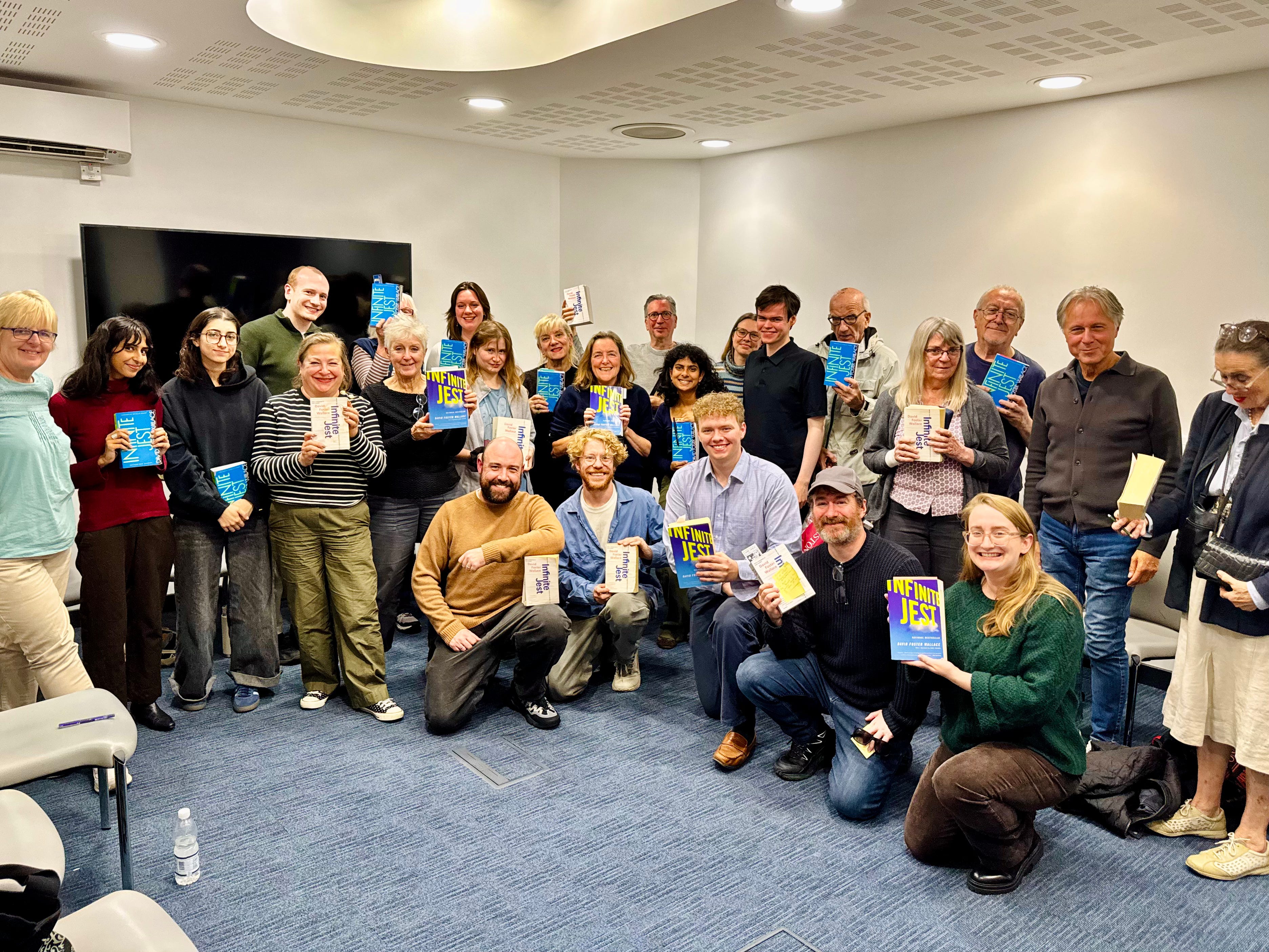
From October 2026 to April 2027, Fearless Fiction is reading, wrestling with, and reveling in David Foster Wallace’s postmodern masterpiece, Infinite Jest, for its thirtieth anniversary.
We are hugely grateful to the British Association for American Studies (BAAS) for sponsoring and supporting the project’s in-person edition, which guides a dynamic group of Londoners over the course of sixteen discussion sessions. Each week, participants read a section of Infinite Jest in advance and analyse the text together at the John Harvard Library in Southwark, London.
The digital edition of Fearless Fiction (this Substack) will explore and celebrate Infinite Jest in conjunction with the in-person group’s sixteen sessions. Its primary objective is to help a wider audience online use Infinite Jest to change the way we see ourselves, our neighbours, and our world. As a result, it will aim to offer a broad introductory guide to Infinite Jest informed by the group’s in-person discussions but capable of exploring the text beyond them.
References to page numbers correspond with the 10th Anniversary Edition from Back Bay Books, an imprint of Little, Brown and Company (ISBN: 9780316066525). This pagination matches that of the 30th Anniversary Edition from Little, Brown Book Group (ISBN: 9780349121086).
David Foster Wallace, Infinite Jest (New York: Little, Brown and Company, 2006), 128.
Wallace, Infinite Jest, 198.
Wallace, Infinite Jest, 199.
Wallace, Infinite Jest, 199.
Wallace, Infinite Jest, 219.
Wallace, Infinite Jest, 222-223.
Wallace, Infinite Jest, 233.
Wallace, Infinite Jest, 238.
Wallace, Infinite Jest, 239.
Wallace, Infinite Jest, 238.
Wallace, Infinite Jest, 251.
Wallace, Infinite Jest, 252.
Wallace, Infinite Jest, 256.
Wallace, Infinite Jest, 200.
Wallace, Infinite Jest, 203.
Wallace, Infinite Jest, 205.
Wallace, Infinite Jest, 203.
Wallace, Infinite Jest, 204.
Wallace, Infinite Jest, 257.
Wallace, Infinite Jest, 218.
Wallace, Infinite Jest, 229.
Wallace, Infinite Jest, 229.
Wallace, Infinite Jest, 243.
Wallace, Infinite Jest, 242,
Wallace, Infinite Jest, 220.
Wallace, Infinite Jest, 220.
Wallace, Infinite Jest, 220.
Wallace, Infinite Jest, 240.
Wallace, Infinite Jest, 238.
Wallace, Infinite Jest, 184.
Gen. 1:3 (King James Version).


