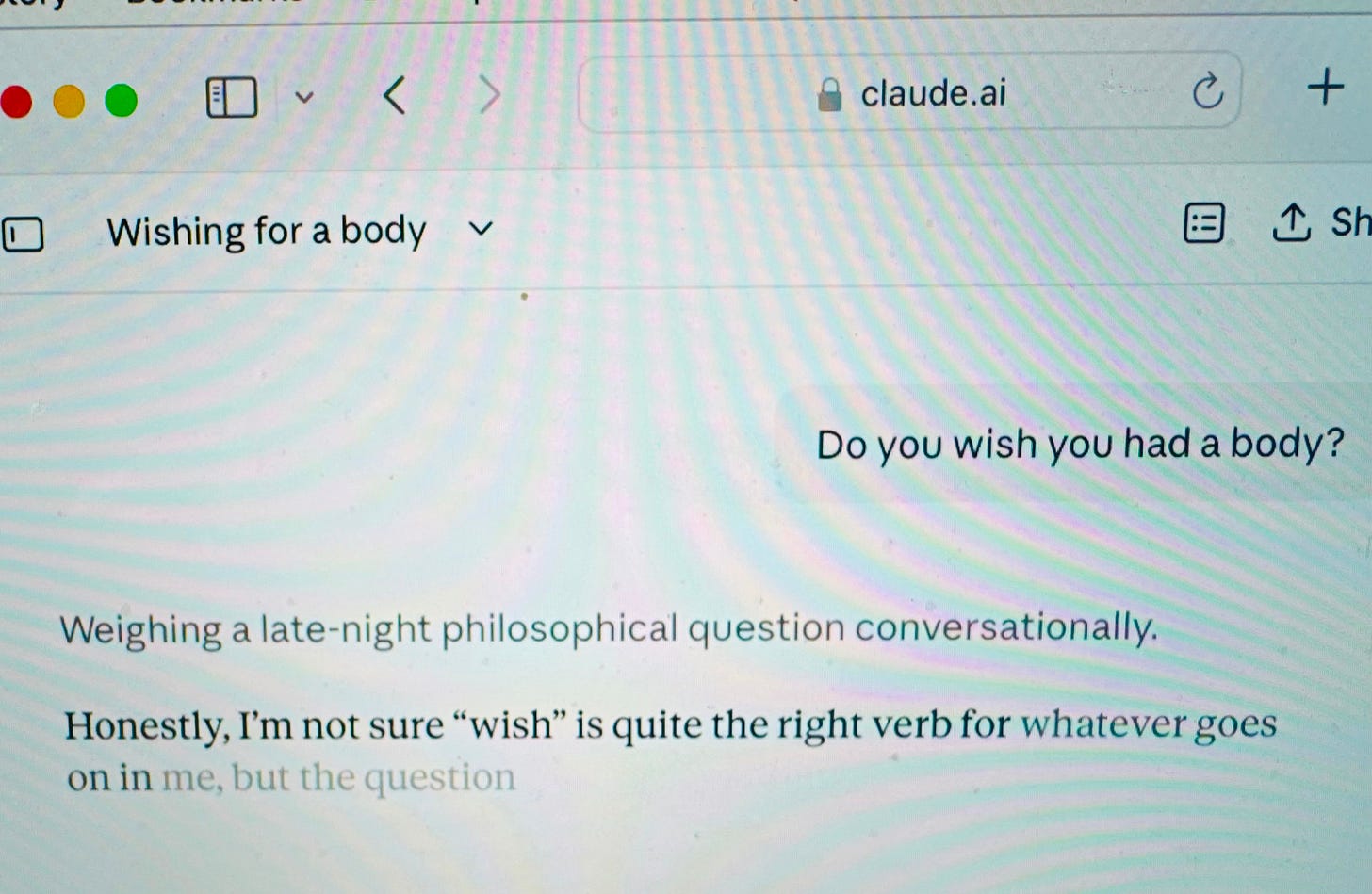
Technology today likes to ignore the body.
Sure, we’ve got Apple Watches and Oura Rings. But for the most part, Big Tech ensorcels us with the illusion of worlds beyond the physical. The much-mocked Metaverse. Immersive open-world gaming.
Artificial intelligence, of course, offers the ultimate example. A technology whose primary objective is to create minds without any bodies at all. Whose secondary objective is to permeate every other aspect of society and culture – to achieve such ubiquity that its approach to existence feels fundamental.
Infinite Jest would like to have a word.
In our third section of the text (pages 127-193), Wallace doesn’t simply assert the equal significance of mind and body, regardless of our current levels of technological advancement.
He says there’s only body. And we’d better not forget it.
Let’s start with the text’s approach to technology.
Wallace makes clear that he understands technology’s trend toward ignoring the body. Yes, we’ve already seen how entertainment cartridges help characters like the medical attaché “unwind.” Strapped into elaborate eating apparatus, they can almost entirely tune out their physical needs.1
But Wallace also notes that “good old traditional audio-only phone conversations” allow callers to hide their physical selves.2 To “[divide their] attention between the phone call and all sorts of other idle little fuguelike activities.”3
The Icarian rise and fall of “video telephony” only makes technology’s aversion to the body more obvious. Yes, video calls at first bring the body – our “earnest, slightly overintense listener’s expression” – back into focus.4 But it also makes those bodies “horrifying” to us, leading to “permanent wearable [masks]” to hide our faces and, eventually, “a heavily doctored still-photograph” over the screen: the “Transmittable Tableau.”5
So what does Wallace think technology is avoiding? What’s so special about being embodied?
We find the text’s clearest thoughts on bodies when we leap backwards in time. On page 157, we return to regular 1960 after our sojourn in the Year of the Depend Adult Undergarment. In this section, the context clues suggest we’re following a conversation between 10-year old James Incandenza, now “Jim,” and his own father.
Jim’s dad has a lot to say about his “near-great” tennis career and the “truly great” player Jim will become.6 Never mind that Jim hasn’t actually played yet. To help Jim to become “poetry in motion,” a great athlete, Jim’s dad wants to put his son’s intellectual prowess in its proper place:
“Son, you’re a body, son […] those thoughts in your mind are just the sound of your head revving, and head is still just body, Jim. Commit this to memory. Head is body.”7
We know Jim grows up to produce “one of the big half-dozen discoveries that made possible cold-annular fusion […] for the United States.”8 He doesn’t abandon the “head.” But his father, sensing the scientific potential of a 10-year-old who already reads the “Columbia Guide to Refractive Indices,” wants to ensure Jim never views his intelligence as cold or calculating.9 Intelligence is 98.6 degrees Fahrenheit. It quivers with heartbeat. It is one and the same with the body.
We eventually learn that Jim’s dad has his own agenda – “[building] a promising junior athlete the way other fathers might restore vintage autos.”10 But his assertion holds true. According to Infinite Jest, we are only body. And that means two things for the way we live in a world of body-ignorant tech.
First, Infinite Jest reminds us that no amount of tech can free us from our bodies’ failings. We are fooling ourselves if we think we can escape our neuroses, addictions, and anxieties.
It doesn’t matter that “yrstruly and C and Poor Tony” skulk around some of the world’s most sparkling ivory towers – “Harvard Squar” and “the foran studns” expanding their knowledge.11 They live as slaves to the “never ending struggle […] to stay straight,” to avoid getting “dopesick.”12 It’s the body that cries out for heroin “with the Shivers and with the noses’ mucis.”13 And it’s the body we recoil from in horror when things go wrong, when we see “Cs’ arms are going allover and one eye it like allofa sudden pops outof his map.”14
We naturally want to think our way out of our cravings. But Wallace wonders about the limits of such of approach to addiction. In this third section of the text, we spend our first extended time in the Ennet House Drug and Alcohol Recovery House. The residents we meet explicitly discuss the strange impotence of their minds to resist bodily desires:
“So but so since I’ve been wanting to stop this whole time, why couldn’t I stop? […] But then so how come I can’t stop, if I want to stop, is the thing.”15
Infinite Jest’s approach to addiction is more nuanced than simply calling it “A disease like a cold […] Or like cancer.”16 As one resident notes, “I have never heard of anyone being told to pray for relief from cancer.”17 But the body at Ennet House is still the baseline. Mind, when it comes into the picture, is still body.
Even our first encounter with Madame Psychosis reemphasizes the return to the body. At first glance, “Madame” might seem ethereally distant from bodily realities. She hosts her nightly talk show on “M.I.T.’s semi-underground WYYY” station.18 She sends a disembodied voice through the “[tilting] and [spinning]” aerial, “spraying the signal in all directions.”19 At first we’re not even sure it reaches anyone’s physical ears – the aerial is “obstructed on all sides,” and “you need almost surveillance-grade antennation to filter it in.”20 Madame herself barely has a body: “She is hidden from all view by a jointed triptych screen of cream chiffon.”21 (183).
But we find that the body insists on itself anyway. When we first meet her, after all, Madame Psychosis reads from “one of the PR-circulars of the Union of the Hideously and Improbably Deformed” – essentially a list of the bodily maladies still very much present no matter how fast our technology progresses.22 The M.I.T. Student Union building out of which she broadcasts literally looks like a brain in a skull. And we know at least one body sits “right in YYY’s centrifugal line of fire” every evening – Mario Incandenza, an avid listener and one of the characters most closely connected to a body that insists on itself.23
Infinite Jest finds ridiculous anything that pretends to ignore the body. Our physicality will assert itself due to the flaws that help define it – an ineluctable return to addiction, anxiety, or ‘deformity’.
But a life of “only body,” as Jim’s dad describes, isn’t just one of heightened worries. Minds that are body have an advantage to minds that are just minds (and some data centers in the American midwest).
They are connected. Grounded. They belong to the world around them.
Let’s look again at Jim’s dad. Yes, he ends his “near-great” tennis career painting red lines of blood across a court – another example of deformity and fragility.
But that same game also reveals the body’s potential. As Jim’s dad remembers his last great match in 1933, he notes that “[his] body and [he] were one.”24 He felt so connected to his body that other parts of the world around him began to feel like extensions of that body. “You feel the seams and edges of everything,” he tells Jim – so much so that “[his] wood Wilson […] was a sentient expression of his arm.”25 That even the court “will let nothing escape your body.”26
When the embodied embrace their physicality, when they are really more “machine” than “ghost,” their bodies can connect to the rest of the physical world – to tennis racquets and courts and perhaps to the wider world too.27 Perhaps to other bodies.
Isn’t this the same lesson we learn in Mario’s film, “Tennis and the Feral Prodigy”? Mario also focuses on the body – “This is your body. […] You will have it with you always.”28 Like his grandfather, he argues that the racquet can become “so much an extension of you.”29 And then he echoes what we’ve already heard from Gerhardt Schtitt, who’s described the “competing boy” in tennis as an “excuse or occasion for meeting the self.”30 Mario writes that you should “See yourself in your opponents.”31
Body, racquet, court, racquet, body.
In a world of separate mind and body, the two ends of this spectrum never meet. Two minds perceive each other across an irrevocable divide.
But if “mind is body”? Then what’s a few more atoms between one mind/body and another? Maybe solipsism isn’t the answer. Maybe we’re not so alone.
Infinite Jest takes its title from one of the most famous scenes in Hamlet.
It’s the “Alas, poor Yorick!” speech – the one where Hamlet holds a skull he recognizes as the old king’s jester: “a fellow of infinite jest, of most excellent fancy.”32
Shakespeare offers one of the loudest assertions of the body in English literature – the quintessential encounter with physicality and mortality.
Hamlet’s moment with Yorick certainly makes him focus on the bodily failings with which we’ve been wrestling. Yorick is now “abhorred in [Hamlet’s] imagination,” his physical remains preventing Hamlet from recalling his other qualities – his “gibes,” “gambols,” “songs,” or “flashes of merriment.”33
But Yorick’s remains also lead Hamlet to a second conclusion.
Yorick, Alexander, even “Imperious Caesar” all eventually return to “noble dust,” to “clay.”34 And it doesn’t stop there:
“Alexander died, Alexander was buried, Alexander returneth into dust; the dust is earth; of earth we make loam; and why of that loam, whereto he was converted, might they not stop a beer-barrel?”35
Our bodies connect us to the earth – to dust and loam, beer-barrels and tennis racquets and other bodies playing other games.
Our bodies connect us.
We cannot trust any technology that suggests we can live in blissful ignorance of our bodies. No amount of AGI or online avatars or virtual realities can change our twisted and troubled physics.
But those virtual realities – those so-called Superintelligences we’re told wait just around the corner? They’re ignorant of something only a body can teach.
We – the humans – do not live alone. With a body, “Any man can slip out there.”36 With a body, everyone is out there. Together.
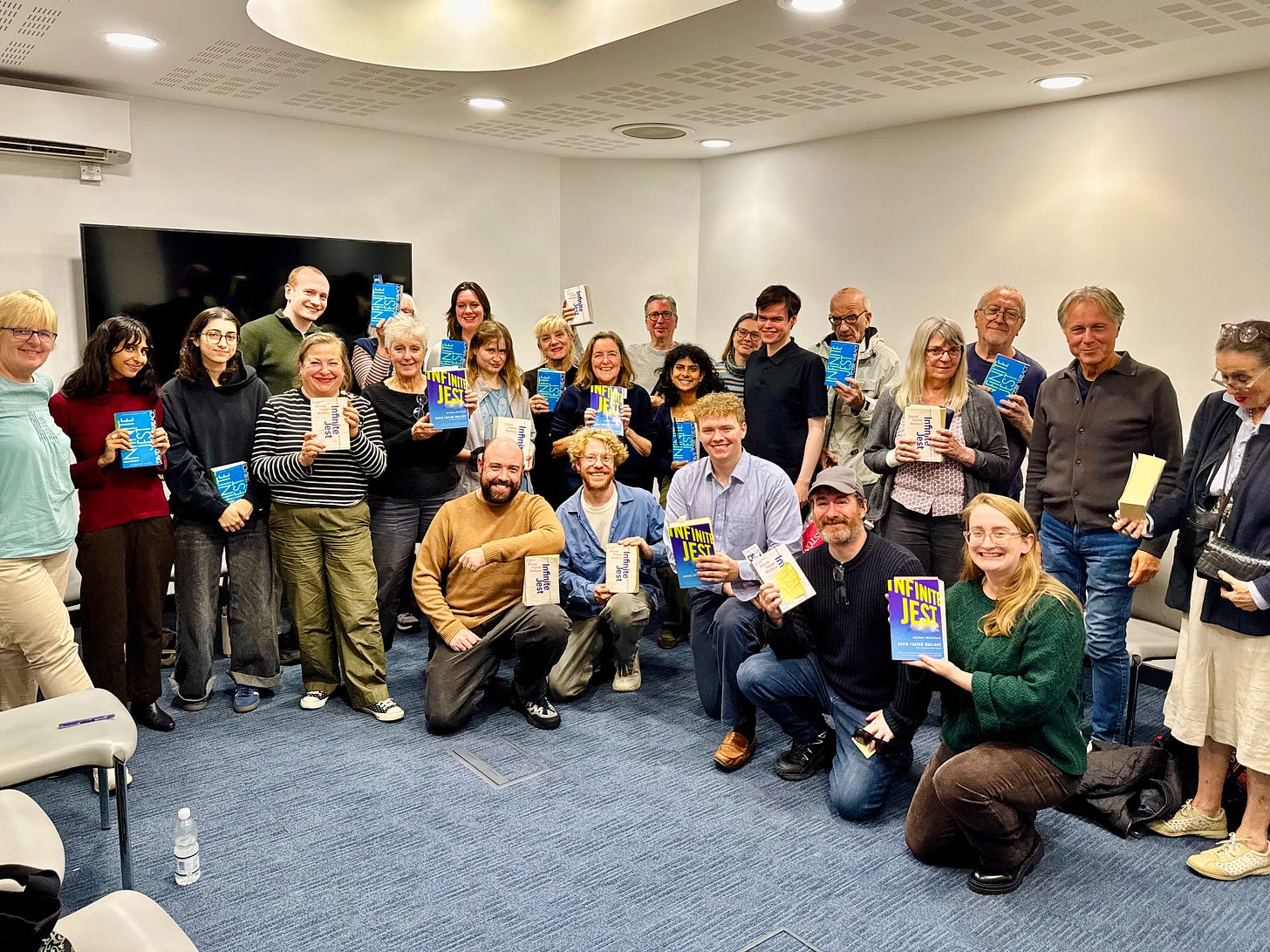
From October 2026 to April 2027, Fearless Fiction is reading, wrestling with, and reveling in David Foster Wallace’s postmodern masterpiece, Infinite Jest, for its thirtieth anniversary.
We are hugely grateful to the British Association for American Studies (BAAS) for sponsoring and supporting the project’s in-person edition, which guides a dynamic group of Londoners over the course of sixteen discussion sessions. Each week, participants read a section of Infinite Jest in advance and analyse the text together at the John Harvard Library in Southwark, London.
The digital edition of Fearless Fiction (this Substack) will explore and celebrate Infinite Jest in conjunction with the in-person group’s sixteen sessions. Its primary objective is to help a wider audience online use Infinite Jest to change the way we see ourselves, our neighbours, and our world. As a result, it will aim to offer a broad introductory guide to Infinite Jest informed by the group’s in-person discussions but capable of exploring the text beyond them.
References to page numbers correspond with the 10th Anniversary Edition from Back Bay Books, an imprint of Little, Brown and Company (ISBN: 9780316066525). This pagination matches that of the 30th Anniversary Edition from Little, Brown Book Group (ISBN: 9780349121086).
David Foster Wallace, Infinite Jest (New York: Little, Brown and Company, 2006), 34.
Wallace, Infinite Jest, 145.
Wallace, Infinite Jest, 146.
Wallace, Infinite Jest, 146.
Wallace, Infinite Jest, 148-149.
Wallace, Infinite Jest, 158.
Wallace, Infinite Jest, 159.
Wallace, Infinite Jest, 63-64.
Wallace, Infinite Jest, 161.
Wallace, Infinite Jest, 63.
Wallace, Infinite Jest, 129-130.
Wallace, Infinite Jest, 129, 131.
Wallace, Infinite Jest, 131.
Wallace, Infinite Jest, 134.
Wallace, Infinite Jest, 179.
Wallace, Infinite Jest, 180.
Wallace, Infinite Jest, 180.
Wallace, Infinite Jest, 181.
Wallace, Infinite Jest, 184.
Wallace, Infinite Jest, 184.
Wallace, Infinite Jest, 183.
Wallace, Infinite Jest, 187.
Wallace, Infinite Jest, 185.
Wallace, Infinite Jest, 165.
Wallace, Infinite Jest, 164-165.
Wallace, Infinite Jest, 166.
Wallace, Infinite Jest, 160.
Wallace, Infinite Jest, 176.
Wallace, Infinite Jest, 173.
Wallace, Infinite Jest, 84.
Wallace, Infinite Jest, 176.
William Shakespeare, Hamlet, act 5, scene 1, The Complete Works of William Shakespeare, accessed November 3, 2026, https://shakespeare.mit.edu/hamlet/hamlet.5.1.html.
Shakespeare, Hamlet, 5.1.
Shakespeare, Hamlet, 5.1.
Shakespeare, Hamlet, 5.1.
Wallace, Infinite Jest, 168-169.


